
Does this look familiar?
Wow. Claude. Mind-blowing. The whole feature works great. But I forgot to mention one very important edge case.You’re absolutely right! Let me fix that.Ah, and I just noticed. You used offset pagination for the table UI. Obviously cursor pagination is a better fit here?
 You’re absolutely right! Let me fix that.
You’re absolutely right! Let me fix that.Also, is that an N+1 query? Fetching for every row in the table? Why not do a single round-trip?
You’re absolutely right! Let me fix that.This is why I still have a job, right?
…
Peak Slop
I’ve watched this scene play out many times, but the frequency is decreasing. Both my tools, and my methods for using them, continue to improve. I think Peak Slop has already come and gone.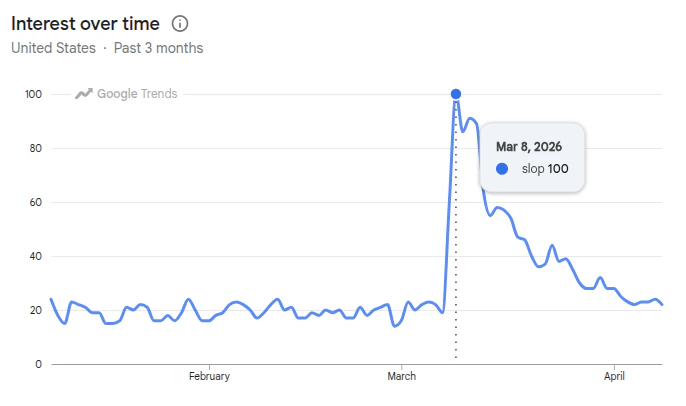
Occurrences of the word 'slop' in the code review comments left on my pull requests.
Specifying the plane while we fly it
What’s your favorite flavor of spec? AREADME.md and AGENTS.md is a good start. Don’t forget a testing-guide.md. Maybe an architecture.md, a PRD.md, and a design doc too. Have you considered md.md (to teach your agents how to write .md)? The more .md the better, right?
Unironically, yes. Docs and unstructured specs can get you very, very far. Much farther than prompts alone. If you aren’t writing any docs yet, you should just stop reading this and start there.
And remember, slop in, slop out. Nothing beats an organic, pasture-raised, hand-written spec. Spec-writing is where the act of software engineering really happens.
So a few weeks ago, I started asking myself, how far can I take this? How far should I take this?
Dreaming in markdown
As the story goes, I fell into an AI psychosis, I became a “spec maxxi”, and I spent hours and hours writing the most beautiful PRDs and TRDs you’ve ever seen. I drafted templates and skills and roles, thinking that maybe my agents can write specs too! I assembled an army, working together like a mini dark factory, to turn my specs into reality. My tasks grew more ambitious, and at one point I broke the vibe-coding sound barrier: an agent that ran for 1.5 hours unsupervised! Exciting. But what did that army ship for me? Well, it wasn’t slop, in fact it worked, which is more than I can say about the garbage that other companies force me to use every day. But it was still a bit sloppy. I’m far from a perfectionist and I love cutting corners more than most, but this somehow wasn’t good enough. One hallmark symptom of AI psychosis is using AI to build AI harnesses for building products, rather than just using AI to build the damn product. I embraced my illness, threw out the branch, scrapped all my markdown, and started all over again.Acceptance Criteria for AI (ACAI)
A few days later, I noticed an ambitious little sub-agent doing something unexpected.- Perhaps these tags can help me navigate these massive PRs?
- Perhaps they can point me to where, exactly, a requirement is satisfied or tested!
- Perhaps I can annotate them with notes and states (todo, assigned, completed)!
- Perhaps I can start tracking acceptance coverage instead of test coverage!
- Can my ACIDs number and label themselves?
- Is it cumbersome to keep them aligned?
- How do I share specs and progress across sandboxes, branches, features and implementations?
Acai.sh - an open-source toolkit
I built Acai.sh to solve some of these newly invented problems. And I’m very excited about the results.- A simple and flexible template for feature specs, called
feature.yaml. Feature.yaml makes it possible to reference each requirement by ACID. - Tiny CLI to power your CI and your agent (available on npm or via github release).
- Webapp that serves a dashboard, and a JSON REST API (Elixir, Phoenix, Postgres).
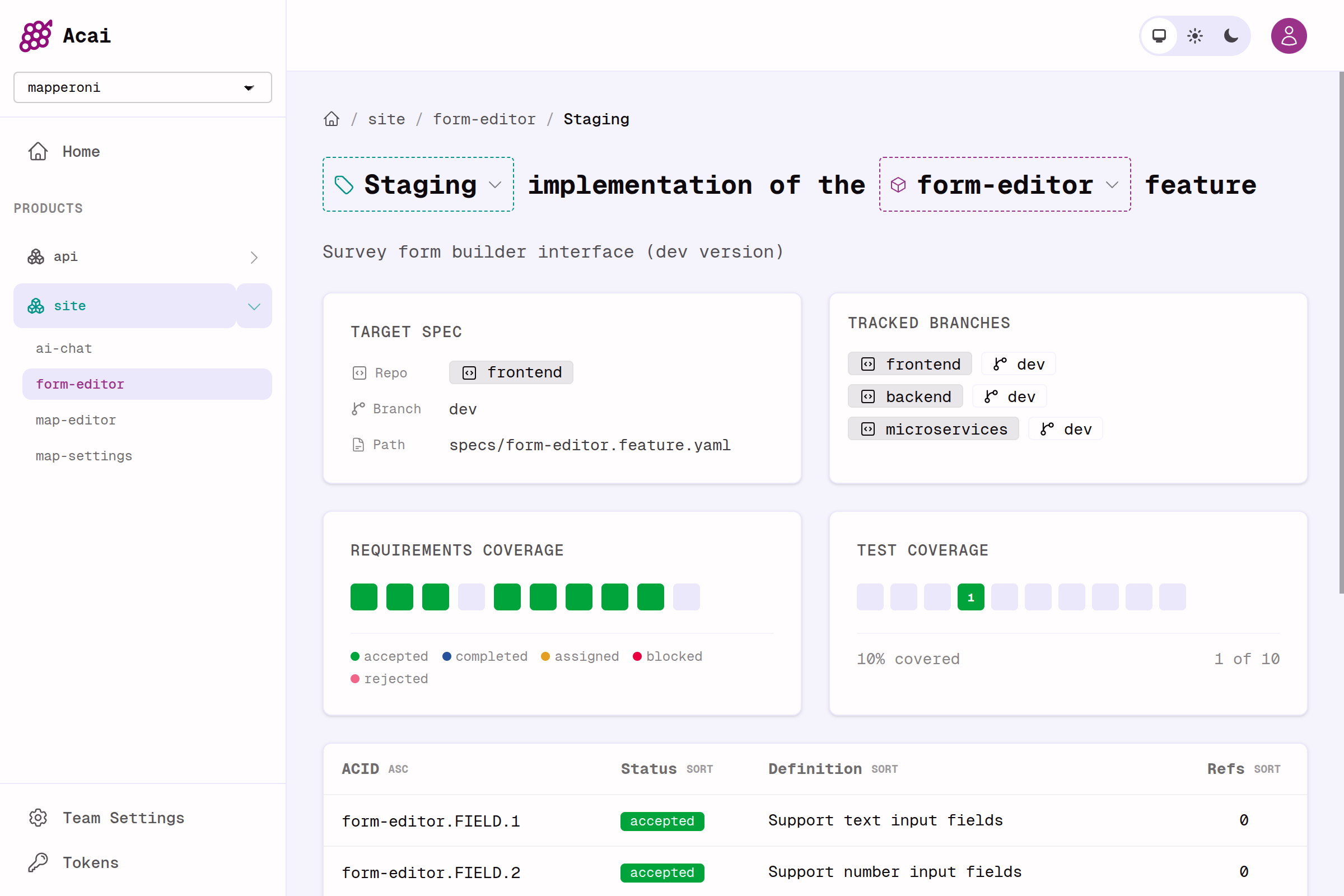
See implementation status at a glance. This screenshot shows progress on the Staging implementation of a feature called 'form-editor'.
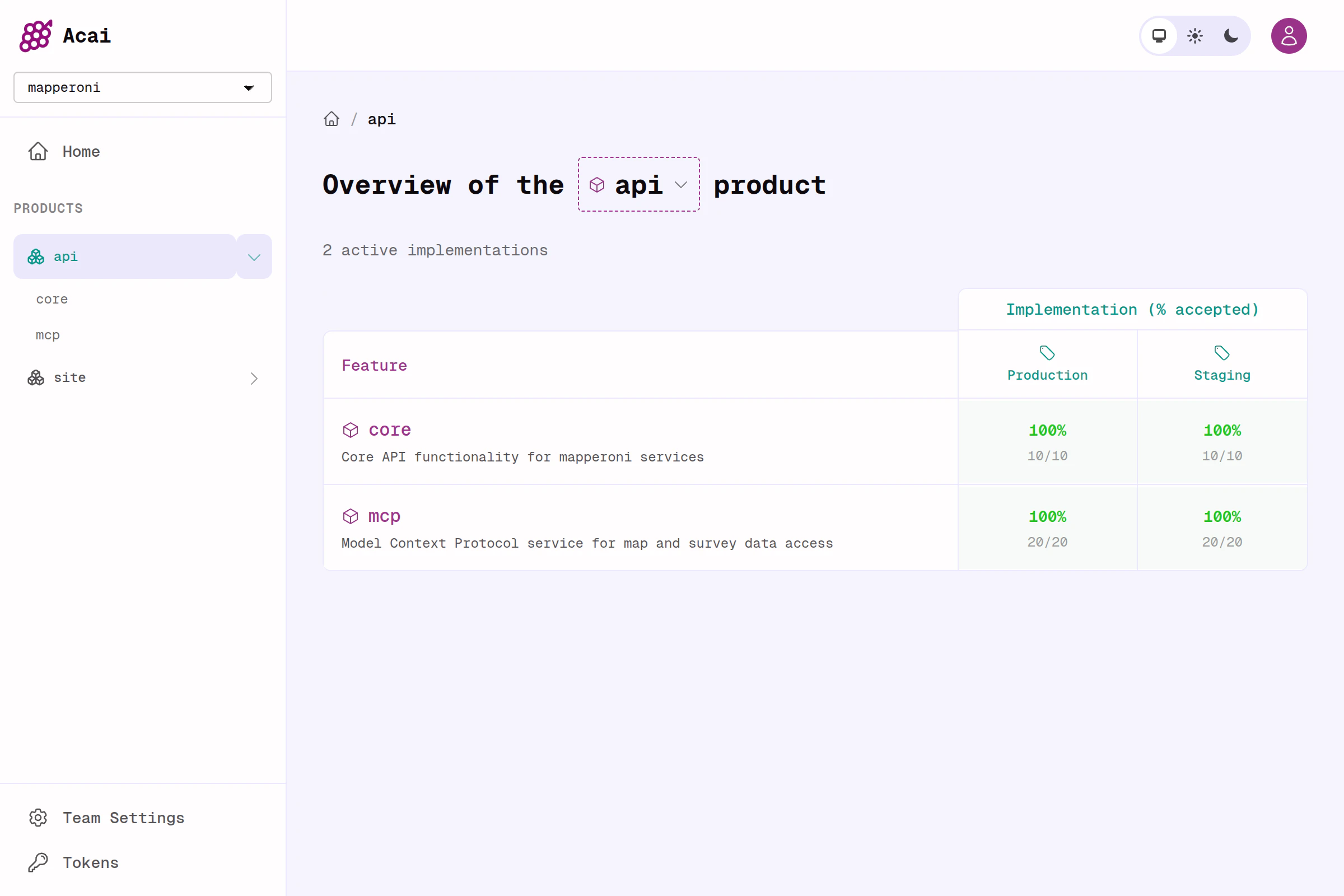
Your team can have many products. Your product can have many implementations, and many features.
How it works
Step 1 - Specify
Start by writing a spec for a feature. Be ambitious— something that adds real value. Don’t put nitpicky UI and nail polish stuff in your specs. Keep the requirements concrete, testable, and focused on what really matters (functional behavior + critical constraints). Rather than markdown, use acai’sfeature.yaml format instead. A spec in Acai is just a numbered list of requirements.
feature.yaml
my-feature.ENG.2.
Step 2 - Ship
Copy and paste the prompt below.Step 3 - Review
No more file-by-file GitHub PR reviews. Use the Acai.sh dashboard to review requirements instead. Ideally, you just addacai push to a GitHub action (example CI/CD workflows coming soon).
- Create a free Team and Access Token at https://app.acai.sh
- Expose the environment variable
- Push specs and code refs to the dashboard for review
Step 4 - Iterate / repeat
The goal is to work spec-first. Change the spec itself, or use the dashboard to attach notes to the spec. With the right harness, you can get your agents to react and self-assign (usingacai CLI commands).
The result should be less time spent prompting and re-prompting, less time reviewing, less sloppy code generation, and far more time thinking about what you want your product to be.
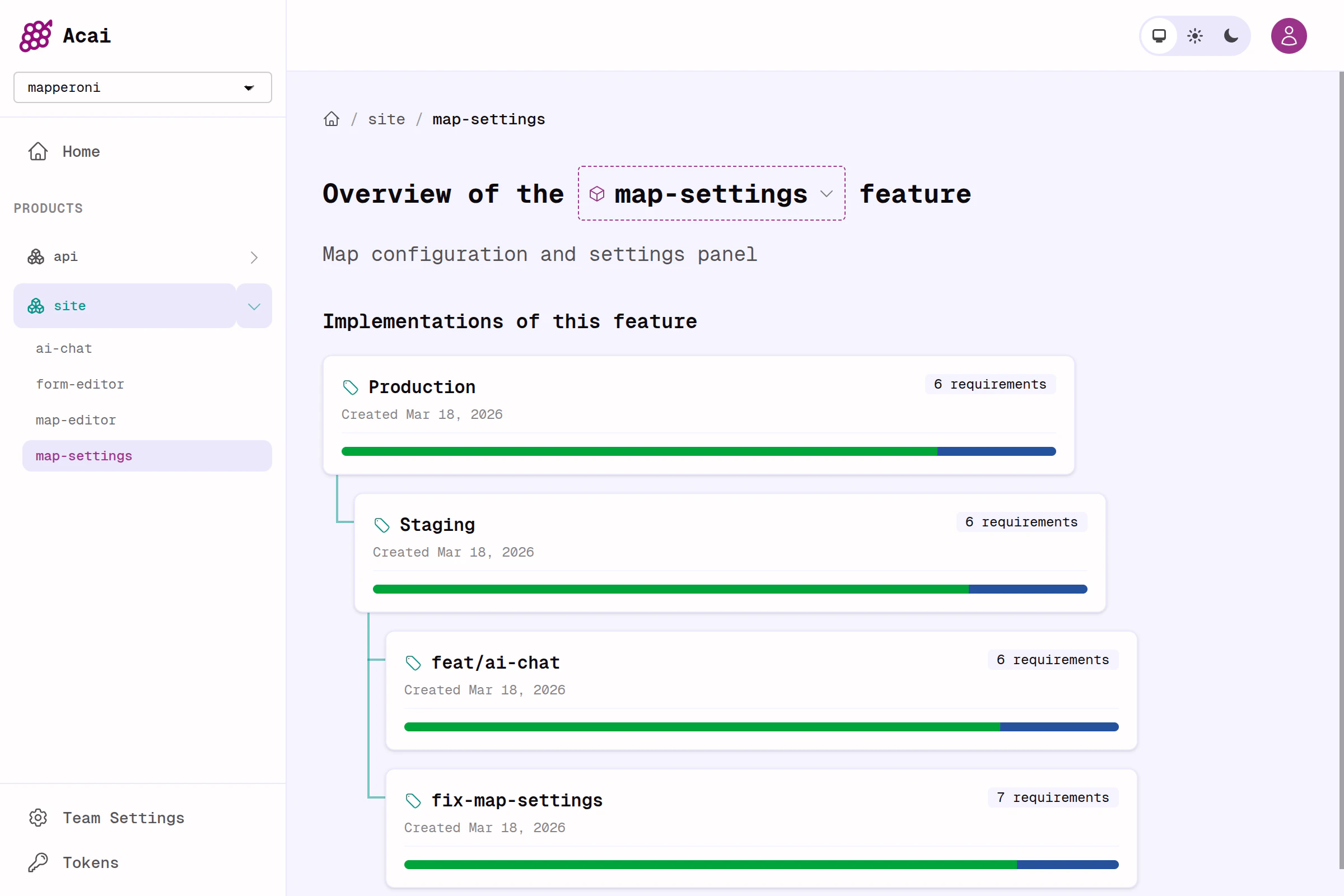
In the real world, a feature can have many implementations and versions, with varying states of progress.
plan → implement → review loop. That part is not included (yet). I plan to share some powerful examples of that soon.
Future Gazing
Even coming out my LLM psychosis, I’m still finding this approach useful and productive. I believe I’ve found the sweet spot between rigour and vibes, structure and flexibility. Maintaining an itemized list of acceptance criteria encourages me to step back and focus on the things that matter, and to rethink how I test and validate my output. Again, none of these ideas are really new. But I feel the gravitational pull, and I’m wondering where it all leads, and what comes next.Thought Experiment
Imagine your entire application, however complex, was generated instantly the moment your fingers started typing in the prompt window. Imagine that magically, the same prompt input always created same deterministic output, and cost you nothing, and was ready in milliseconds.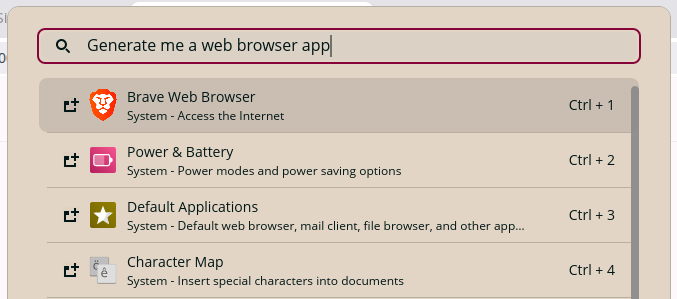
What if generating software was like typing in the quick-access panel?
feature.yaml is.)
A few more things follow from there;
-> From Specsmaxxing to Testmaxxing
When code is generated faster than you can read it, the bottleneck moves to QA and validation and your confidence that the code is to-spec. So investing heavily in QA automation and test coverage has a massive ROI. And after that, after maximal test coverage and observability has been achieved, our attention shifts away from the diffs in GitHub; we need a place to relate the specs to the important artifacts (the implementations, the QA feedback, user feedback, builds, runs, reviews and reports). Maybe Acai.sh can become that place. For now, it is only focused on the specs and their implementations in code.-> From Testmaxxing to reactive software factories
The final unlock is when your LLMs can react to a red test or alert. If the specs are well defined, and you have high confidence in your integration pipelines and QA, then the LLM is fully empowered to react without the need for you to intervene. It seems every well-funded software team on earth is currently busy building their own bespoke solution for this and I’m excited to see what works and what doesn’t. As a first step, I put some OpenCode Agent templates on http://acai.sh that have been working well for me so far.Comparison to other spec-driven development tools
Embarrassingly I did not know about any of these until I was almost finished building my own. The key differentiator is that Acai.sh is focused on helping you track acceptance coverage and spec alignment across many implementations, which is a slightly different problem than what other tools are trying to solve. I can not offer unbiased feedback, because I suffer from Not Invented Here syndrome. It may even be the case that the Acai.sh approach actually enhances these tools.GitHub SpecKit
SpecKit reads to me like ‘vibe coding with extra steps’, i.e. a CLI that augments your agents with more prompts and more skills. This is surely productive, but it is solving a slightly different set of problems.OpenSpec
The first thing I noticed when reading their docs, is their stated mental model, which is written: “Specs […] describe how your system currently behaves.”. I fundamentally disagree with this. In Acai.sh, specs describe how your system SHOULD behave. Current behavior is transient. In addition, their process appears to lean into “AI generated spec writing”, which has never gone well for me Lastly, the process of versioning and diffing specs is just basic gitops, and I don’t need a CLI for that. Same goes for the agentic ops and task creation (Vanilla OpenCode does just fine, thanks).Kiro
I don’t like EARS syntax, but I don’t like unstructured markdown either, and Kiro claims to convert the latter into the former. Acai is different— I came up with feature.yaml to strike a balance between unstructured markdown and cumbersome EARS / gherkin. Unlike Kiro, Acai.sh does not try to solve end-to-end delivery either (yet).Traycer.ai
Looks like a very useful product for managing artifacts and spawning agents to implement them. But they are still plain-old .md files. Acai is more opinionated about how you should write the spec (feature.yaml).Reasons you might not like acai.sh
Like any tech, it comes with tradeoffs;- You might not need to write specs. If your product is low-stakes, or simple, just keep prompting.
- Acai specs are opinionated. You should write 1 spec per feature (though the feature boundary or slice is up to you). My opinion is that cross-cutting feature specs are easier to iterate, and really shine when a feature touches many codebases (frontend / backend / microservice etc.) and has many implementations (Production, Staging, Fix, etc.)
- ACIDs rely on stable numbering. This creates zero friction when drafting a new spec, but requires care when revising a spec: you must re-align the code whenever your spec changes (almost forgot that this is the whole point?). The feature.yaml syntax supports
deprecatedandreplaced_byflags as well, if you want to maintain a complete spec history inline. - Acai discourages you from putting design and superficial requirements in your specs. Specs are for behavior, and constraints, and nothing else. I’ve learned from experience: get it working to-spec first, then do the superficial nail polish last 💅🏼.
- Acai requires you to adopt the feature.yaml format. Almost zero learning curve. I have written an introductory guide to writing them. I recommend reading that first. Use
npx @acai.sh/cli skillto teach your agent how. I also wrote a spec-for-the-spec if you want to go deeper.